
F1's 2026 rules backlash: when your most credible voices become your loudest critics
What Formula 1's 2026 rules fight teaches any organization whose stars are off-message.
Every organization has people the public believes more than the organization itself: engineers, frontline staff, players. When those people turn critical, the instinct is to defend the product with numbers. That instinct is usually wrong, and the backlash to Formula 1's 2026 rules shows why. Here are four stakeholder communications lessons from our analysis.
The case: drivers vs. Formula 1's 2026 rules
In 2026, Formula 1 moved to a hybrid engine with a near 50-50 split between combustion and electrical power. The sport's best-known drivers, including Max Verstappen, soon said the cars no longer rewarded driving skill: they lifted off before fast corners to recharge the battery and spent qualifying laps managing energy. The governing body, the Fédération Internationale de l'Automobile (FIA), and the commercial rights holder, Formula One Management, defendedthe rules.
We tracked the fight from February through September. The evidence base is 180 public statements, including every official FIA press conference, plus 2,861 fan comments and 15 race-rating polls. Four lessons stand out.
1. Map which stakeholders are moving, and why
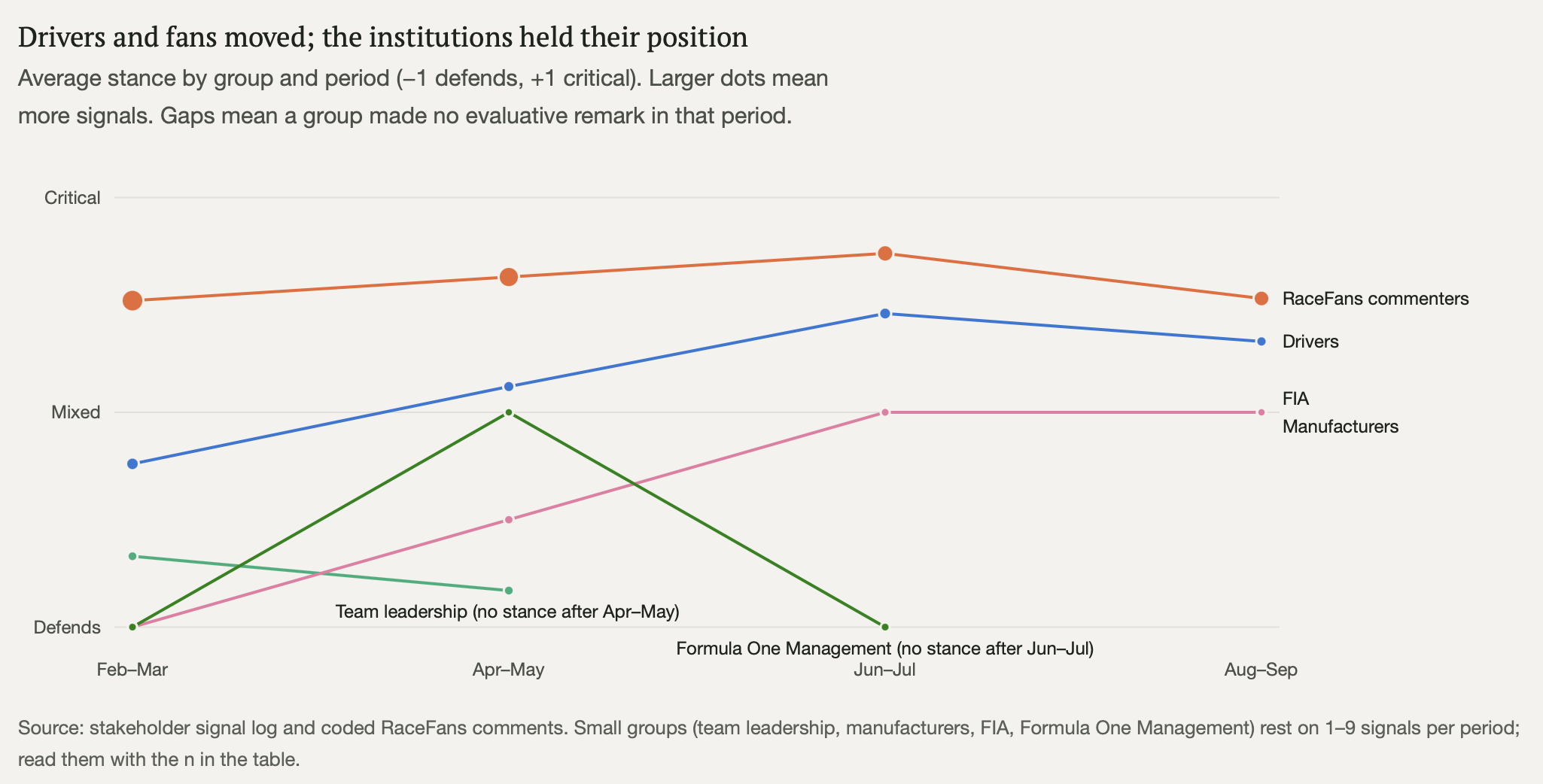
The headline was “drivers hate the new rules.” The record was more specific. At the opening races, drivers on balance defended the rules. By summer they were clearly critical. But that shift came almost entirely from drivers outside Mercedes, the team that started the season fastest. Mercedes drivers defended the rules all year.
Criticism broadened, but it peaked at about a third of drivers and never became a consensus. A critic's position often tracks their interests. That doesn't make the criticism wrong. It tells you who can be persuaded and what would persuade them.
2. Answer critics in their frame, not yours
Each group argued about something different. Drivers talked about driver skill. Manufacturers talked about competitive balance. Formula One Management answered with spectacle and business: record attendance, audience growth and survey scores.
Real numbers, but answers to a question nobody asked. When a driver says the car doesn't reward skill, “attendance is up” sounds like not listening. If you answer in your own frame instead of your critic's, you can win the argument on paper and still lose the audience.
3. Fixing the problem is not the same as owning the story
The rules did change. Adjustments, officially “Refinements,” were in force about five weeks after criticism peaked. A larger rebalancing for 2027 and 2028 was agreed by June. But those changes followed a governance timetable. What tracked criticism week by week was communication, and it mostly defended the product.
The result: the sport fixed part of the problem without getting credit for it. The 2027 changes move toward what critical drivers wanted. Nobody owned that story in the drivers' language.
4. Never manage the messenger: trust is the real cost
Fans were critical from the start: about three in four of those taking a position on the rules. Yet they rated the actual races no worse than in 2025. The evidence suggests the rules weren't driving fans away; the handling of the criticism was costing trust. Institutional trust was the second-largest theme in fan comments.
The largest cluster followed a report of Formula One Management's chief executive saying fans don't understand energy management and think the racing is great; the next, accusations that a broadcast hid it. Autosport also reported that Formula 1 cut a podium remark by Max Verstappen from its social posts; we found no second source. The lesson holds either way: once people believe you are editing your critics, every reassurance becomes evidence against you.
Key takeaways for stakeholder communications
When your most credible voices turn critical:
• Map who is moving and why before you respond.
• Answer in their frame, not yours.
• Make sure any fix comes with a story that credits the people who pushed for it.
• Don't touch the messenger.
Read the full F1 Factions case study, with interactive charts and every source. For another sport under pressure, see our analysis of the PFL–MVP merger. And if your most credible voices are turning critical, talk to Town2.
Town2's analysis is independent. It was not commissioned by, and is not affiliated with or endorsed by, Formula 1, Formula One Management, the FIA or any team.
